
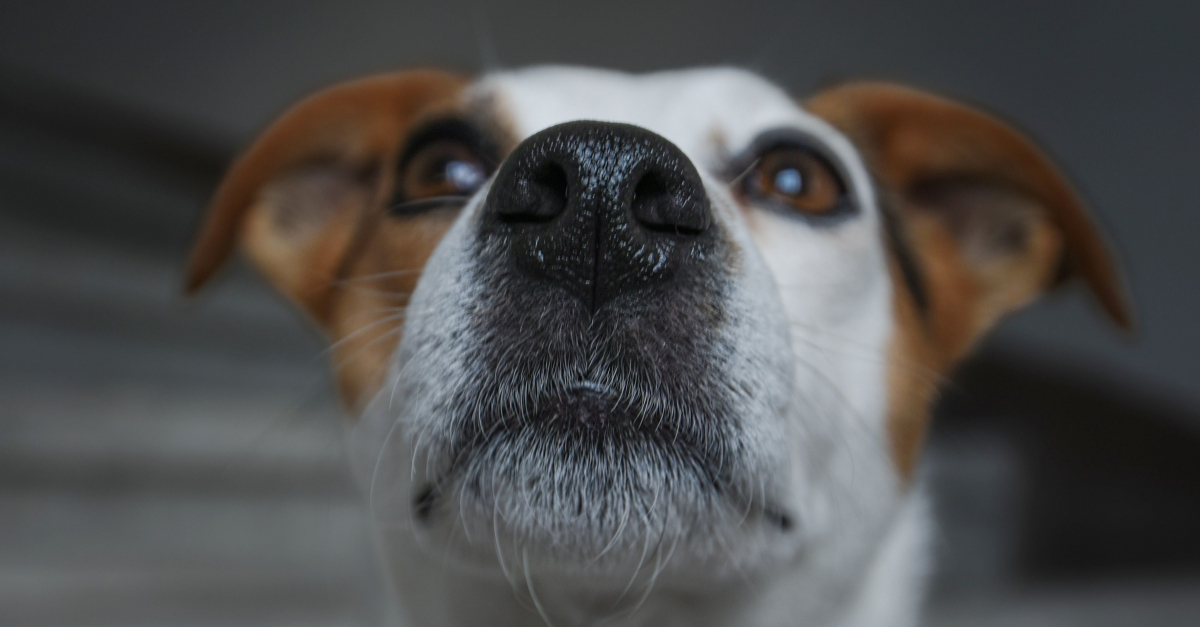
No need for a mirror to know who you are… at least for our dog friends! Their incredible sense of smell could indeed allow them to recognize their own olfactory signature. A researcher imagined an original experiment to test this hypothesis and better understand how dogs perceive themselves.
What if, to know if a dog recognizes itself, you had to forget the mirror and use your nose? Dogs are able to understand complex social situations and solve some amazing tasks. Yet they fail the famous “mirror test,” often used to study self-recognition. But is this test really suitable for an animal which primarily explores its environment with its sense of smell? This is the question that was asked Alexandra Horowitz of Barnard College in a study published in the journal Behavioral Processes*.
The olfactory mirror test
To test this idea, the researcher imagined a sort of “olfactory mirror”. Rather than asking dogs to recognize themselves in their reflection, she set up an experiment inspired by their natural behavior, based on their sense of smell and their olfactory cognition.
36 domestic dogs were thus invited to explore different containers containing odors. Among them: their own urine, the urine of another dog, but also a modified version of their own smell. The goal was to observe how long the dogs would be interested in each of these odors.
Are dogs self-aware?
This experiment provided an interesting clue, but not a definitive answer. Indeed, dogs explored their own scent more when it had been modified with another scent, such as anise oil, than when it was presented alone. So they seemed to notice that something unusual had been added to their “personal chemical signature.”
For the scientist, these results suggest that dogs are capable of recognizing their own scent and detecting when it changes. But be careful not to go too quickly: recognizing yourself is not necessarily synonymous with self-awareness. In humans, self-awareness involves much broader abilities, such as memory, emotions and understanding one's own relationships with others. This study above all shows the existence of a form of olfactory recognition in dogs, without allowing us to affirm that they have a self-awareness comparable to ours. However, it opens the way to new experiences adapted to our 4-legged companions whose world passes more through smells than through images.
* Horowitz A., “Smelling themselves: Dogs investigate their own odors longer when modified in an “olfactory mirror” test. », Behavioral Processes, 2017, 143, 17-24.