

Once upon a time there was a woman who always wanted to be nice to her dogs. She found out about training methods and attended seminars and training courses to learn how to fully train a dog without penalty educates. She quickly learned that problem behavior had to be redirected and reinstated positive alternative behavior that has been built up is also effective, that you can always be nice to your dogs if you confirm early enough and that all punitive measures would lead to a fearful and helpless dog.
Advertising
The method of choice was this Clicker in her hand, she learned a lot about reinforcement systems and how they can be used in work. The lady was thrilled! Finally a nice way to deal with dogs, without any punishment. She quickly decided that other dog owners should also experience this and made one Dog school on. The slogan was emblazoned on their website “I only work positively with dogs through rewards”. And if she hasn't died, she's still clicking today.
Reality in dog training

A fairy tale? Unfortunately reality. But the fairy tale of the whole story is a very crucial point: In reality, training and the entire dog ownership process are without punishment not possible.
What is perceived as punishment here? Punishment comes in one learning theoretical sense understood, that is, either as positive punishment (adding an unpleasant stimulus, which causes the behavior to occur less) or as negative punishment (a pleasant stimulus is withdrawn, which is why behavior occurs less).
However, this is also rejected negative reinforcement. Here, removing an unpleasant stimulus reinforces a behavior. This is problematic because you have to add an unpleasant stimulus beforehand in order to be able to remove it afterwards. In plain language, this means that this effect occurs in conjunction with the positive punishment, which is rejected. Only one thing remains: them positive reinforcement where something pleasant is added to make a behavior occur more often.
Of course that sounds nice and many people fall for the “work with positive reinforcement” scam. Simply adding a reward to make a behavior occur more often is one nice idea and is often practiced. For example, instead of punishing a dog for bullying, you can teach it an alternative behavior, such as looking at the dog owner when you see another dog.
As positive as this all sounds, is training only possible using positive reinforcement? No, it's not that.
In training and in everyday life, you always work and live with punishments – whether positive or negative. To get to the bottom of this, you have to look at it Definitions of punishment recall again.
Negative punishment

You can't avoid this form of punishment in training. Even when a dog lies down instead of sitting and for that not rewarded this is a negative penalty. The dog is deprived of something pleasant (reward like a treat) that he actually expects, with the aim of making the “down” behavior occur less often when the “sit” command is given. This form of reinforcement also occurs clearly “positively structured demolition squad” out.
To convey a “no” message to the dog, it is often advised to show him a treat and to close your hand every time he goes for it so that he cannot reach it. Only when he withdraws will the treat be released. Closing the hand here clearly means a negative penalty.
Already at “free shaping” With the clicker you have to do with this circumstance. Here the dog is rewarded in very small steps for finding his own solutions – there is no help from the owner. However, if the dog tries a behavior that it shouldn't do, the “click” and the associated reward will not occur. This is a negative punishment because the dog will not perform this behavior again in the future. This phenomenon is particularly evident when you have always rewarded the dog for a certain behavior before and the next time you no longer do so so that he tries something again.
People who Tricks Those who practice with their dogs in this way can tell you what it's like to keep the balance between reward and punishment so that the dog doesn't become demotivated. A negative punishment ultimately affects the dog. He feels it not as pleasant and in the worst case scenario refuses to cooperate. Especially since he goes through the frustration You can also develop other undesirable behaviors that you actually wanted to avoid with “purely positive work”.
Positive punishment

Ultimately, positive punishment is also unavoidable. You keep giving your dog negative stimuli that you don't care about not conscious is. A dog that walks on a leash and is not yet on a leash may jump onto the leash when another dog appears. No matter what harness and no matter what leash you use – there is a clear one Jerk. This jolt is not pleasant. That too Hold back on the harness (even if this was previously set up with a positive signal) is a measure that punishes positively.
If you don't believe that, you can put a backpack on yourself and ask someone to hold it to it. Even if it doesn't hurt, it's definitely uncomfortable to have your freedom of movement restricted like that from behind. This doesn't just apply to walking on a leash. Also training measures for “walk through the door decently”make use of this learning theory penalty. It is often said that if a dog tries to rush through the door, it is best not to get there. This means that the door is closed as soon as the dog wants to rush forward. This is of course a positive punishment and, depending on the dog, it can even result in a “doddle” in the nose.
Of course, the negative punishment also works here, because the dog is deprived of the pleasant stimulus of “going outside”. It is clear that the types of punishment and reinforcement often overlap and that there is a clear one demarcation is often not possible in everyday life.
Needs-based reward

This is also mentioned again and again in the “purely positive” work. Ultimately, the problem is that one intended reward not reinforcement must be.
As an example: the dog wants to go hunting and listens to a command, then he doesn't find the treats offered by the owner particularly interesting. That's not what he wants right now and so this reward, which is supposed to reinforce the behavior, is not perceived as such. “Purely forcing” would be more of a positive punishment.
It certainly does sense reward the dog in a needs-oriented way. Instead of waving treats, you can, for example, let a bag of food fly as a “hunting substitute” or use digging at the mouse hole as a reward.
What actually is a Need? A need is generally perceived as a desire Shortage to eliminate. So a defect can not perceived as positive become. Wherever rewards are based on needs, there was previously a deficiency that the dog could not or was not allowed to satisfy itself.
If I let the dog hunt within a tolerable framework (for example by running after the food bag and not the game), then this only works because the dog is not allowed to hunt game and therefore has a deficiency.
If you confirm eye contact with social proximity, then this only works because the dog previously had a deficiency. If you let the dog work for his food outside, then you are using the lack of food to get him to cooperate. After all, food is always a particularly strong need in dogs, who can never really seem to get full. Working with treats also relies on exactly this. If you don't believe that, you can try leaving everything your dog likes to eat lying around. He will quickly find out that the dog sees this as Reward in training no longer accepted.
Conclusion: Dog training without punishment is unthinkable
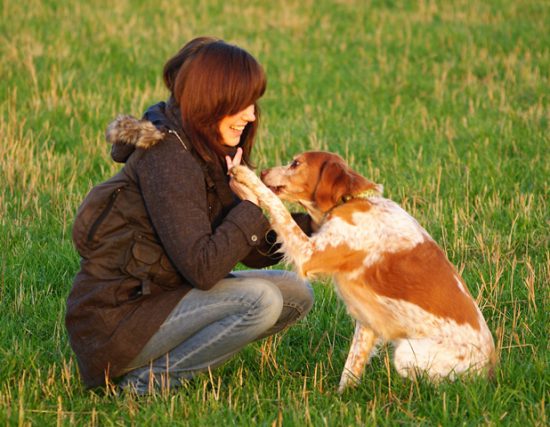
My comments here are by no means a rejection of the work, which is predominantly about positive reinforcement running. However, they should clarify that dog owners and trainers who boast that they work “exclusively through positive reinforcement” are also error are. Any training is unthinkable without punishment. Any reward is not possible without a state of deficiency. This is not always pleasant for the dog. The whole one pink worldwhich some people construct, does not exist.
So the question doesn't arise whetherrather How how to punish and how to adapt it to each dog. Especially since it is questionable whether a trainer who apparently has no idea that he is also punishing in his “purely positive training” and taking advantage of the dog's deficiencies really knows what he can achieve with his type of training and where possible “pitfalls” lie.
I think it's completely legitimate to want the dog if possible “sweet and kind” to treat. It is perfectly legitimate for dog owners to object to punishments such as electric shocks or prong collars. However, it is completely out of the question that dog trainers are involved empty promises and Empty words They can give the owners the illusion of an ideal world and thereby make a lot of money. A trainer who prides himself on having a good understanding of learning theories should take this into account Implications Be aware, educate yourself about it and look for the right path with the dog owners that suits them and the dog. And this far away from ideological thinking and any glorified worldviews.
Author: Nina Dany