
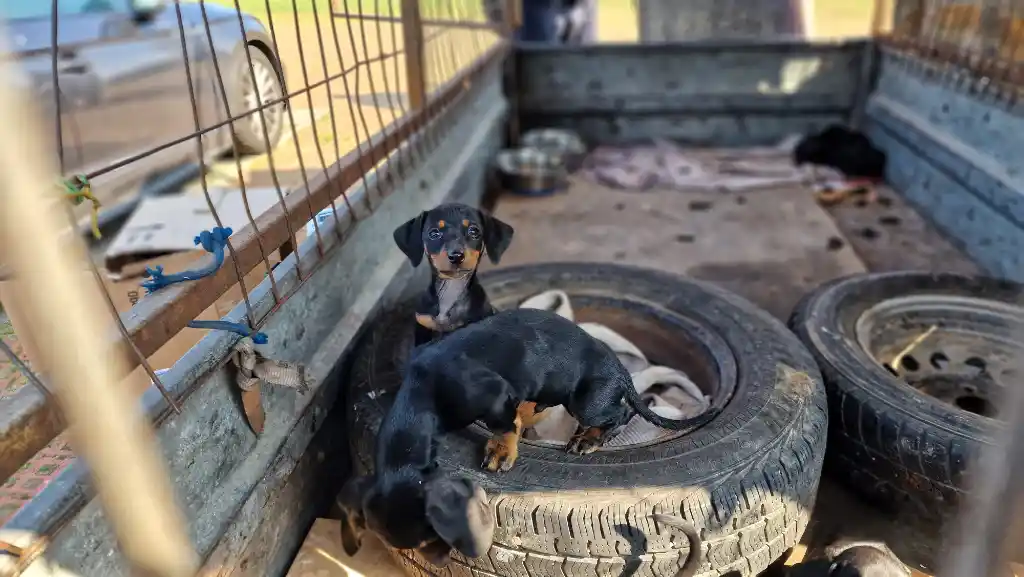
Hamburg. From January to the end of March, the global animal welfare foundation FOUR PAWS recorded 171 illegally traded animals in a total of 21 cases of illegal trade – including 148 dogs and 23 cats. In Bavaria alone, 77 animals (45 percent of the total) were caught. The numbers of illegally traded puppies in the first quarter of 2026 show a similar trend to 2025: Back then there were 162 animals in 26 cases in the first quarter, and 737 animals in 81 cases in the year as a whole. As FOUR PAWS also analyzed in the recently published report for 2025, small breeds will continue to be particularly in demand in the illegal trade at the beginning of 2026.
“The horror continues in the first quarter of this year: 171 illegally traded dogs and cats have already been caught in Germany; the youngest puppies were just four weeks old. These are almost always purely coincidental finds by the authorities – so the number is just the tip of the iceberg,” says Saskia Dauter, expert on illegal puppy trade at FOUR PAWS.
Still particularly popular: small breeds
Small dog breeds such as dachshunds, French bulldogs and Maltese as well as poodles and poodle mixes continue to be particularly popular in the illegal puppy trade. These currently trendy breeds are often offered online for the same prices as animals from breeders.
 Only recently, a van with nine dachshund puppies was discovered by the highway police in Sinsheim, Baden-Württemberg, which was on its way from Romania to France. Michael Sehr from the Rhein-Neckar professional animal rescue service was called in to ensure the safety – at this point the puppies had already been traveling for over ten hours in a transport box and a cardboard box that were far too small, completely urinated and full of defecation. Michael Sehr says: “The illegal puppy trade is a huge business and is almost impossible to get under control. What's particularly bad is the indifference with which living beings are treated here – and the enormous number of unreported cases. We can confiscate animals at the site, but while we are enforcing these measures, several transports with the same problem may drive past us unnoticed.”
demands on the federal government
FOUR PAWS is calling on the federal government to make improvements and make it more difficult for criminals to trade in animals: “This year, a regulation is to be passed at EU level that will regulate online trading and introduce a labeling and registration requirement for dogs and cats. We expect the federal government, among other things, to ensure that during implementation it will ensure that the owner's data is checked in the pet register and that only advertisements in online trading where the registration has been verified are published,” says Saskia Dauter from FOUR PAWS.
Background information
In order for a puppy from the EU to be allowed to enter Germany legally, it must be fully and demonstrably vaccinated against rabies to protect animals and people and have a valid EU pet passport. Puppies cannot be effectively vaccinated against rabies until they are twelve weeks old at the earliest. After a waiting period of three weeks, the vaccination protection takes effect. Accordingly, puppies from other European countries must be at least 15 weeks old in order to be allowed to legally enter Germany. If puppies come from an unlisted third country, such as Russia, they must be at least seven months old to be transported across borders. Illegally traded puppies are often born under catastrophic conditions in so-called breeding stations, separated from their mothers far too early, often not cared for in a species-appropriate manner and in many cases suffer physical or mental consequences for the rest of their lives – if they even survive the ordeal.
Was this amount interesting or helpful?
Your rating shows us what you and your furry friend like – it's like a treat for us.