
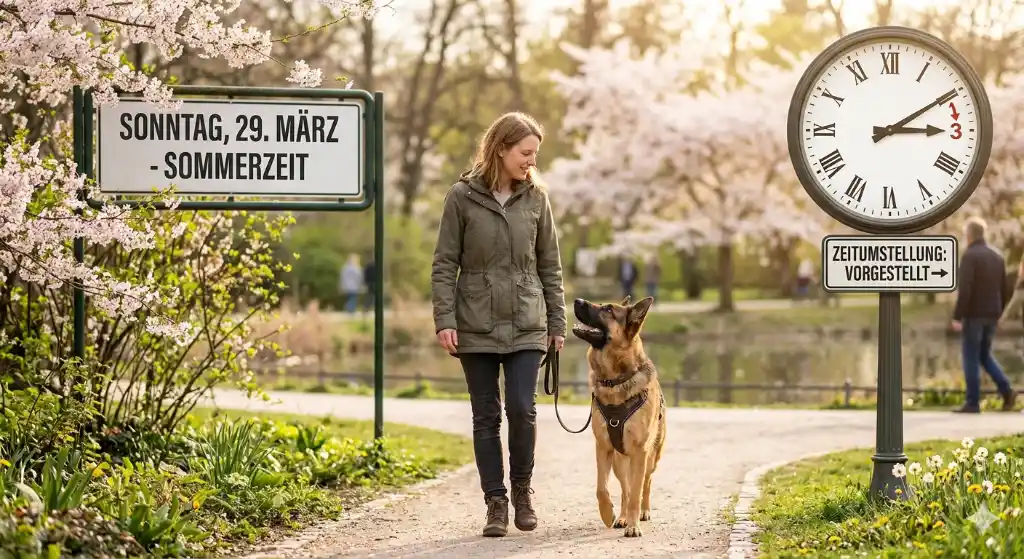
When the dog's internal clock works overtime
 Boppard. On Sunday, March 29th, the clocks will be set forward from winter time to summer time from two a.m. to three a.m. While we humans are annoyed about the “lost” hour of sleep or look forward to the longer evenings in the daylight, millions of pet owners have a completely different question: Does my dog actually know that it is later and does my dog even feel it – and if so, how strongly? Even though dogs can't read the clock, they are very sensitive to routines, lighting conditions and their body's internal clock. That's exactly why it's worth consciously accompanying the change.
The dog as a creature of habit
Dogs are masters of routine. Their entire daily routine – from the first stretch in the morning to feeding times to long walks in the forest – is often strictly timed. They are guided less by the wall clock and more by their biorhythm and external stimuli such as the incidence of light or the noises in the neighborhood.
When the time change occurs, we humans suddenly postpone our activities by a full hour. For the dog this means: the owner suddenly gets up earlier and the bowl remains empty for an hour longer (at least it felt like) and the evening round takes place in completely different lighting conditions. Those particularly affected are:
- Dogs with fixed feeding times who “demand their meal” very punctually.
- Dogs with sensitive digestion or health restrictions.
- Dogs that react strongly to daylight, such as older animals or those with vision problems.
- Dogs with anxious or insecure temperaments who perceive changes more intensely.
Is the biorhythm getting messed up?
Yes, the dog's biorhythm can be disturbed. Biologically speaking, dogs are also subject to the circadian rhythm, which is controlled by hormones such as melatonin (sleep-wake rhythm) and cortisol (activity level) is controlled. These hormones respond to light and habits – not the time. That's why the sudden shift by an hour can cause irritation. Many dogs show “mini jet lag” in the first few days:
- Unexpected restlessness or “begging” before the actual time.
- Changed digestion times (important for planning dog walks!).
- Due to changes in sleep phases, fatigue during the actually active phases.
- Unrest at the usual dog walking times.
This usually levels off within a few days. For sensitive dogs, however, it can take up to a week for the body to fully catch up.
Prepare the dog optimally To ensure that the transition on March 29th goes smoothly, gentle preparation is the magic word. If you don't want your four-legged friend to stand in complete consternation in front of the empty bowl on Monday morning, you can take countermeasures days in advance and thus enable a smooth transition. The following measures have proven particularly effective:
- The 10 minute rule: About four to five days before the change, start moving all fixed appointments, such as feeding or walking, by 10 to 15 minutes towards the new time. The organism gradually gets used to the new rhythm.
- Light management: Since light controls the hormonal balance, it can help to let the dog out into the daylight a little earlier in the morning or open the curtains earlier to gently adjust the waking rhythm.
- Radiate serenity: Dogs are empathy world champions. If we are stressed because we had an hour less sleep, they sense it. Remain confident – an hour difference is ultimately not a biological drama for a healthy dog.
- Medical precautions: If your dog needs medication at fixed times, be sure to consult your veterinarian. Here the adjustment should be particularly precise.
This turns an hour of change into a barely noticeable transition, and it helps the dog to better accept the new rhythm.
The time change on March 29th is a bit of a challenge for people and dogs, but with a little foresight it won't be a problem. As we turn the watch on our wrist, we should gently take our dogs' “internal clock” with us. After two to three days at the latest, most four-legged friends have gotten used to the new rhythm – and are enjoying the first spring sun of the summer with us. On Sunday, October 25th, it's time to 'roll backwards' – the time change to winter time. (SR)
Was this amount interesting or helpful?
Your rating shows us what you and your furry friend like – it's like a treat for us.