

Hannover Veterinary University Foundation appeals to pet owners: Please do not leave dogs in the car when it is hot!
Hanover. In high summer temperatures, the car can quickly become a life-threatening heat trap. The Hanover Veterinary University Foundation (TiHo) therefore appeals to all dog owners: Never leave your four-legged friend in the vehicle when it is hot!
A quick shop, a quick trip to the parcel shop – even if the time seems so short, the car heats up quickly. Even with an outside temperature of 20 degrees Celsius, the interior of a non-air-conditioned vehicle can reach 46 degrees after an hour. At 30 degrees Celsius, this value is exceeded after just half an hour. Temperatures that can quickly become life-threatening for dogs!
 “Dogs are particularly at risk of overheating in the car. They can only regulate their body temperature to a very limited extent,” explains Professor Dr. Sabine Kästner from the TiHo small animal clinic. “Unlike humans, they only have sweat glands on their paws and nose and regulate their body temperature almost exclusively by panting. The evaporation surface is limited, so cooling quickly reaches its limit – especially if the ambient air does not circulate, which is the case in an enclosed space such as a car,” says the expert.
Risk of heat stroke
What many people don't know: “The dog's ability to cool down by panting is already impaired when the ambient temperature is above 28 degrees Celsius,” warns the veterinarian. The risk of the animals suffering heat stroke is therefore very high. The health consequences of overheating depend on the level of body temperature and the duration: If a dog suffers mild heat stress, which is manifested by tiredness and heavy panting, and is cooled down in a timely manner, the prognosis is positive that the dog will recover and will not suffer any permanent damage. In the case of a fully developed heat stroke, however, the animal's health quickly becomes critical.
“We speak of a full-blown heat stroke when a core body temperature is over 41 degrees Celsius,” reports Kästner. “The animals show symptoms such as bloody vomiting and diarrhea, and they have neurological symptoms such as convulsions or loss of consciousness.” If the body temperature rises to more than 43 degrees Celsius, heat stroke is usually fatal.
The danger to the dog's life in the event of heat stroke is considerable: despite intensive medical treatment, the mortality rate for affected animals is 50 to 60 percent.
Brachycephalic breeds – i.e. short-nosed dogs such as pugs and bulldogs –, old animals and dogs with thick fur, overweight or previous illnesses are particularly at risk.
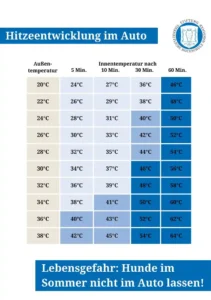 It is important to Kästner to emphasize that an overheated animal should always be taken to a veterinary practice – even if it has apparently recovered. Heat stroke can also have long-term health consequences, including chronic kidney disease or functional impairment of the muscles and nervous system. “If you find a dog that is overheated, you should take the animal to a shady place as quickly as possible and cool it down. Air conditioning and ventilation also help on the way to the vet,” says the expert.
“But what’s even more important is that dogs – and all other animals – should never be left in the car in summer,” Professor Kästner urgently appeals to all owners.
Burns on the asphalt
Footpaths and streets can also pose a danger to dogs in the current extremely high temperatures: the ground, especially asphalt and dark stone slabs, heats up so much that it can burn dogs' paws. Dog owners are therefore recommended to check the surface of the path before going for a walk: simply press the back of your hand on the ground for seven seconds. If it is too hot for your hands, the temperature is also too high for the dog's paws.
“In this summer weather, we recommend that all dog owners reduce the activity for their animals and schedule walks in the early morning and late evening hours,” says Professor Kästner. “If there are heat-related abnormalities, burns on the paws or sunburn, the dogs should be taken to a veterinarian.”
Important signs of overheating
- Very strong, jerky panting with a tense face. Profuse salivation (increased drooling).
- Restlessness, nervousness or on the contrary: apathy and apathy.
- Movement disorders such as staggering or swaying.
- Glassy or staring gaze.
- Redness of the mucous membranes and the insides of the ears.
- Nausea, vomiting or diarrhea.
- Panic behavior: The dog runs and tries to get out of the car, scratching at doors or windows.
- Disturbances of consciousness up to and including unconsciousness.
- In severe cases: cramps, bluish discoloration of the mucous membranes (cyanosis), circulatory collapse.
First aid measures
- Dog (get out of the hot car) move to a cool, shady place.
- If available, with cold (anything below the body temperature of 37 to 40 degrees Celsius is helpful).
- Pour water over or immerse, create a draft.
- Offer water to drink, but do not give it (force).
- If you are unconscious: lie on your side, stretch your head and neck so that the airways remain clear.
- In case of cardiac arrest: mouth-to-nose resuscitation, chest compressions.
- Take dog to vet and cool with air conditioning/fan on the way.
Was this amount interesting or helpful?
Your rating shows us what you and your furry friend like – it's like a treat for us.