
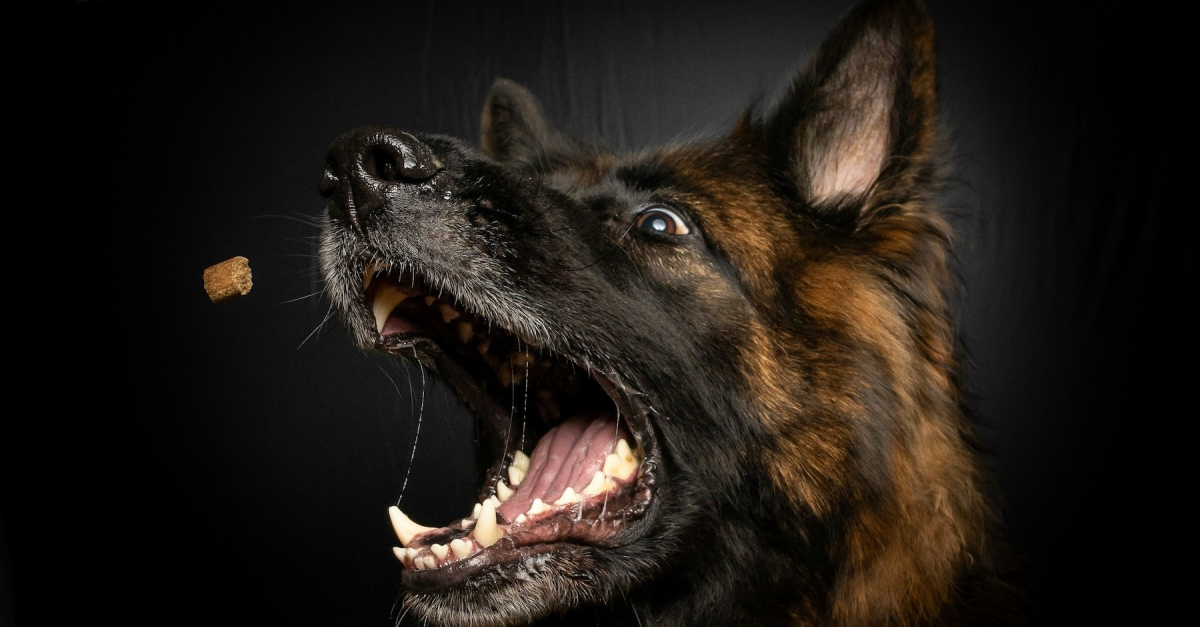
But where can this unfortunate tendency to gobble kibble without even chewing come from? You should know that the wild ancestors of your faithful companion often had to feed quickly before a stronger congener stole their precious food. This competition for access to resources has left its mark, even on doggies living today in the comfort of a sweet home.
Some dogs retain this instinct more strongly than others. This is for example the case of those who grew up in a large litter, where they had to compete for access to the mother's breasts and then to food.
It should also be noted that in a household where several canines eat at the same time, the fear of seeing their meal disappear can push them to swallow their ration at full speed. In others, this behavior is simply linked to a very greedy temperament or to trauma (abuse, malnutrition, etc.).
It also happens that an unsuitable diet, insufficiently satisfying or not properly covering the dog's nutritional needs, encourages this rush. If the animal seems constantly hungry, we recommend that you seek the advice of your veterinarian to rule out any health problems.
What are the risks?
Swallowing your food without chewing increases the risk of aspiration and digestive problems. A gluttonous dog often ingests a lot of air at the same time as its kibble or mash, which can cause bloating, regurgitation or vomiting after a meal.
The danger most feared by many adopters? Dilation-torsion of the stomach. This veterinary emergency particularly affects large dogs and deep-chested breeds, but no dog is completely safe. The stomach fills with gas and then can turn on itself, interrupting blood flow. Without prompt treatment, the consequences can be fatal.
Likewise, ingesting too quickly promotes poor digestion. The animal may have difficulty assimilating its meal correctly and experience digestive discomfort after eating.
Woopets' advice: how to deal with a gluttonous dog who eats too quickly?
It is possible to help your faithful 4-legged friend slow down his food intake with a few simple habits. Food puzzles, for example, are a great solution. They force him to think and collect his food gradually, which naturally lengthens the meal time while stimulating him mentally.
If you share your cozy little nest with several furballs, we advise you to feed them separately with accessories specific to each to limit the feeling of competition. A calm environment also allows them to eat without stress.
Another point of attention? Physical activity. Avoid strenuous play, running or long walks within 2 hours before and after eating to reduce the risk of stomach torsion, especially in predisposed dogs.
Also remember to choose a quality diet, adapted to their age, size, activity level and state of health to cover their specific nutritional needs.
Finally, positive education helps reinforce calmer behaviors around food, without punishment or frustration. With patience and good little habits, a gluttonous dog can learn to eat at a more reasonable pace. If necessary, do not hesitate to discuss it with a dog trainer.