
One year after an initial inventory, the SPA and the Affinity Foundation (notably known for its petfood brand Ultima) have just published a new edition of their study devoted to abandonment and adoption: “ Animal abandonments in France: understand and act “. Their objective remains the same: to better measure and understand the phenomenon of abandonment in order to better prevent it.
Carried out using 2025 data, this study is based on the testimonies and figures of 880 animal protection structures, among more than 3,000 listed in France. Shelters, associations, pounds and “free cat” stakeholders shared their field experience, making it possible to better estimate the extent of abandonment and understand its realities. This new edition also aims to explore new themes to refine the diagnosis and better act in favor of animals.
A phenomenon that remains massive
According to the study's estimates, nearly 391,000 dogs and cats were taken into care in France in 2025 by animal protection structures. Cats represent almost 3 quarters of the animals taken in (72%), particularly due to wandering and unwanted litters: half of the cats taken in are in fact kittens under 6 months old. For dogs, care is more regular throughout the year and mainly concerns adults (54%).
Behind these receptions, the causes of abandonment are multiple: life changes, financial difficulties, loss of autonomy, allergies or even behavioral problems. For cats, unwanted litters are particularly important.
© SPA / Affinity Foundation
The study teaches us that once collected, animals stay on average 6 months in shelters, but that most adoptions go well: only 4% of dogs and 3% of cats are then brought back to the shelter.
Structures that are saturated and lacking resources
Beyond the figures, this second national inventory also wanted to give a voice to those who, every day, are on the front line to help animals. On the ground, the reality is increasingly difficult: requests for help are increasing, while human and financial resources do not always make it possible to respond.
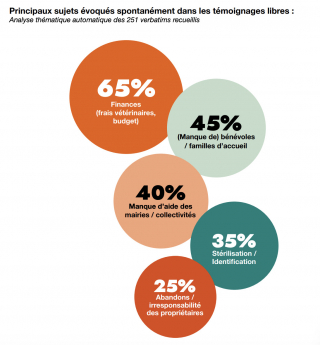
The 251 testimonies collected provide a better understanding of the concerns of the structures and the difficulties they face on a daily basis. Among the main ones are financial difficulties, cited by 65% of responding structures, but also the lack of volunteers and host families, as well as the need for increased support from communities. In total, 78% of the structures surveyed say they are worried about their future.
© SPA / Affinity Foundation
This situation is being felt very concretely on the ground. In 2025, due to a lack of available places, the responding structures had to refuse the reception of more than 45,000 cats and nearly 39,000 dogs. Behind these figures, there are so many animals for which no solution could be found immediately, but also teams who, despite limited resources, continue to mobilize every day and do their best to help them.
The testimony of the shelter SPA of Flayosc (83) powerfully illustrates this reality:
“ The shelter is saturated and requests to abandon are constant, by telephone and email, to which we cannot respond due to lack of space, which is morally difficult. We are also faced with cases of abuse, which makes everyday life emotionally taxing.. »
A focus on free cats
Another new feature of this 2e edition: the study takes a closer look at “free cats”, these stray cats which are captured, identified and sterilized before being released where they live. These field actions play an essential role in preventing births, limiting the proliferation and better supporting stray cat populations.
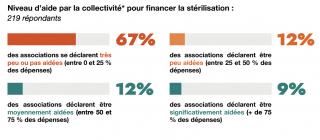
Behind these programs, it is above all volunteers and associations who mobilize on a daily basis. But, here again, the means are lacking to meet the scale of the needs. The structures involved in these actions sterilize an average of 73 cats per year, while 67% say they receive very little or no financial support from their community.
© SPA / Affinity Foundation
This situation is all the more fragile as 42% of associations intervene without a formal framework with communities. However, the management of stray animals is the responsibility of the mayor, in accordance with the Rural Code. In the field, associations are often required to take charge of a large part of the capture, sterilization and monitoring operations, carrying out these essential actions with often limited resources.
So how can we act more effectively?
This study reminds us of one essential thing: solutions exist, provided we act together and above all act sooner. Better support for owners, encouraging responsible adoption, strengthening identification and making sterilization a real preventive reflex are all levers to avoid abandonment and sustainably limit feline wandering.
However, this prevention cannot be fully effective without collective mobilization: associations, volunteers, foster families, veterinarians and communities each have a role to play. Municipalities can in particular strengthen sterilization campaigns, pool their efforts on an intermunicipal scale (cats do not know administrative boundaries!) and provide concrete support to associations which often take over in an emergency.
This dynamic also finds an echo at the European level: adopted in 2026, the new European regulation on the well-being and traceability of dogs and cats establishes for the first time common rules in terms of identification, registration, breeding and traceability.
A step forward which reinforces an essential conviction: to better protect animals and prevent abandonment, we must move from a logic of emergency to a true culture of prevention, at all levels.
For more details, find the complete study “Abandoned animals and those who take them in” on the website of the SPA or that of the Affinity Foundation.