
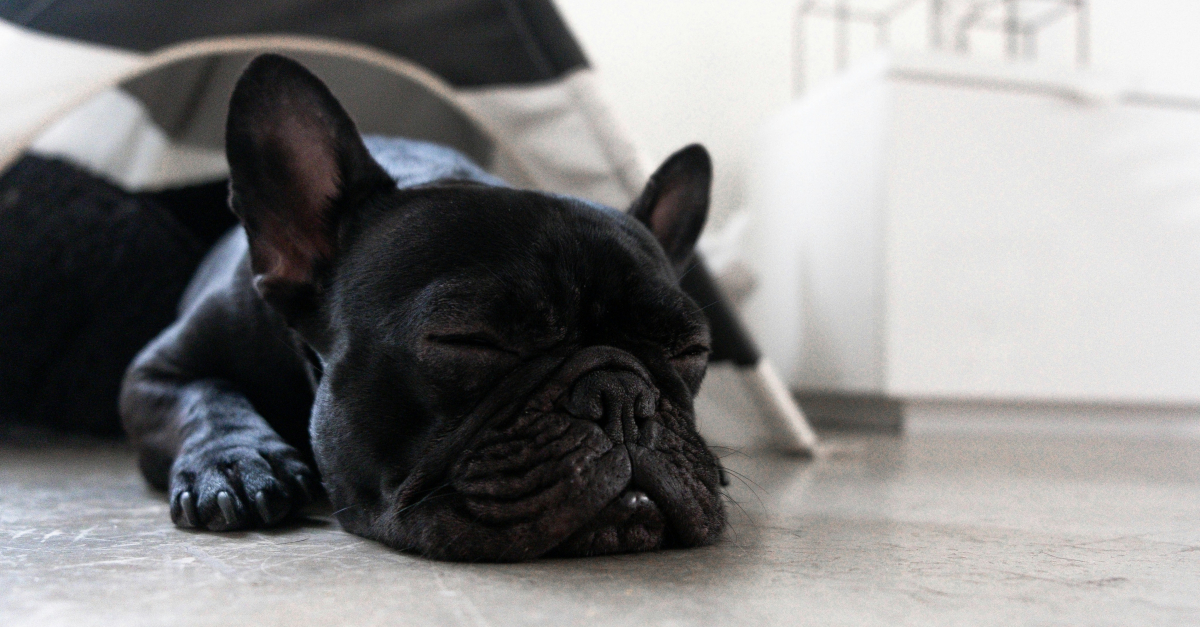
A French bulldog who snores, it's a great classic! So, we easily end up thinking that this is “normal for this breed” and that there is nothing to do. However, behind these small engine noises breathing difficulties can sometimes be hidden. It remains to be seen how to tell the difference between harmless snoring and a sign that merits veterinary attention…
Why do Bulldogs snore so much?
If your French bulldog snores as soon as he falls asleep, his morphology has a lot to do with it! With its shortened skull and flattened snout, its airways are naturally narrower. Stenotic nostrils, a soft palate that is too long or thickened, and sometimes a small diameter trachea can complicate the passage of air and cause these characteristic snoring sounds. These particularities are grouped under the term obstructive syndrome of brachycephalic breeds (SORB). They are part of the morphology of the Bulldogbut can also cause real breathing difficulties.
Several factors can accentuate this phenomenon: excess weight, heat, intense exercise, allergies, irritants present in the air or even certain sleeping positions. A Bulldog who snores from time to time, especially when sleeping on his back, is therefore not necessarily worrying. On the other hand, noisy daily breathing, heavy panting or difficulty recovering after exercise should attract your attention.
When snoring becomes worrying
So, even if snoring is common among French bulldogthis noise should not be systematically considered as a simple peculiarity of the breed. Light snoring, especially during deep sleep, without any particular discomfort and without consequences for the day, can be relatively commonplace. On the other hand, certain signs should alert you.
Be particularly careful if your Bulldog breathes noisily even when awake, quickly runs out of breath with the slightest effort, has difficulty recovering after an activity or does not tolerate heat well. Pauses in breathing during sleep (sleep apnea), breathing that seems labored, discomfort, or gums and tongue that turn a bluish tint (in other words, cyanosis indicating a lack of oxygen) are also warning signs. In these situations, it is best to consult a veterinarian quickly. Significant respiratory difficulty or a bluish discoloration of the mucous membranes also constitutes an emergency.
Woopets info – What can you do to help your Bulldog snore less?
A few small actions can help your Bulldog to breathe better and limit snoring. Without working miracles, they can above all improve daily comfort:
- Watch your weight: extra pounds can worsen breathing difficulties;
- Avoid heat and intense effort: Bulldog tolerates them particularly badly;
- Take care of his sleeping position: a comfortable position, particularly on his side, can make his breathing easier;
- Limit irritants: smoke, dust or perfumes can increase snoring;
- Observe his breathing: watch for changes during his sleep and activities;
- Have him followed up by a veterinarian: especially if the snoring becomes louder or is accompanied by shortness of breath.