
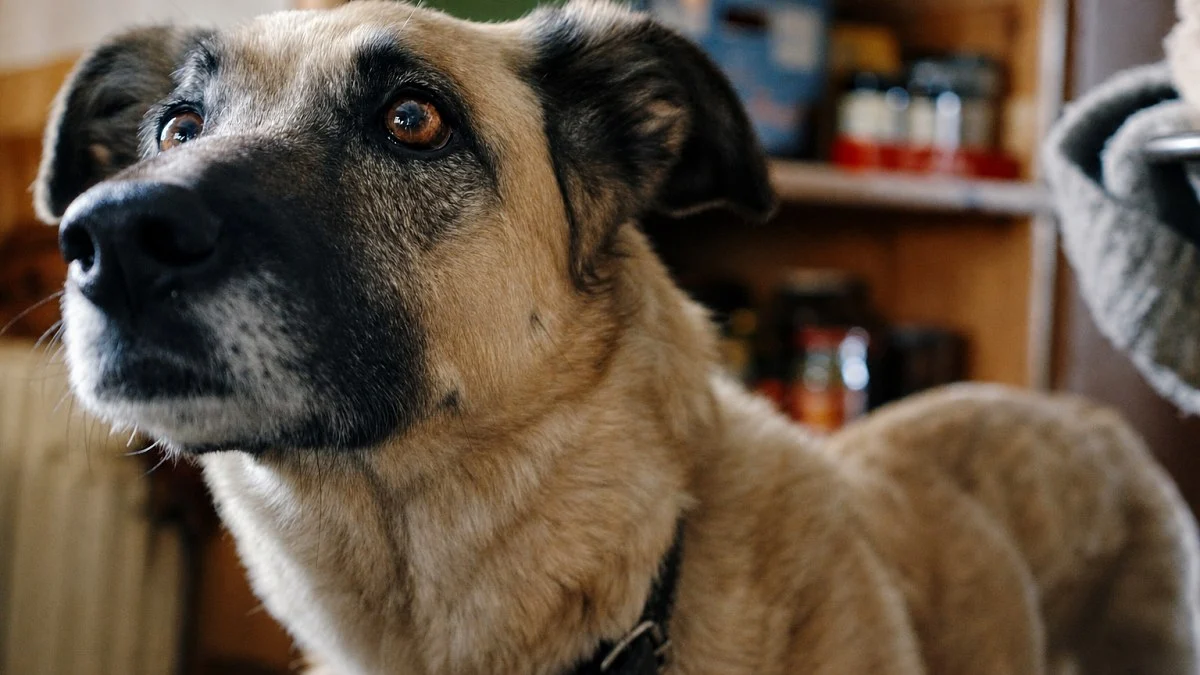
Do our 4-legged friends notice when an event doesn't go as planned? A study, published in the scientific journal Proceedings of the Royal Society B*, shows that dogs look longer at scenes that contradict their expectations and seek more to explore the objects concerned.
This study focuses on the way in which Man's best friend understands the events taking place before his eyes. The researchers therefore wanted to know whether dogs expect an object to remain present when it is not entirely hidden by an obstacle and whether they react when a situation contradicts this expectation.
To verify this, scientists carried out 3 experiments. The first two were based on 3D animated videos. The doggies were watching a ball rolling behind a screen. In a normal situation, it would reappear on the other side. In the other, she disappeared even though the obstacle was not enough to explain her disappearance. The team tracked the canines' gaze and measured the size of their pupils, indicators for assessing their attention and reaction to an unexpected event.
The third experiment, for its part, reproduced a comparable scenario with real objects. This time, the researchers wanted to determine whether a surprising situation made the dogs look more closely at the objects present.
Don’t hesitate to tickle your dog’s curiosity to stimulate him
As we learn in the article, the results of the first 2 experiments go in the same direction. Indeed, the doggies looked longer at the scenes where the ball disappeared unexpectedly than at those where it reappeared normally. Their pupils were more dilated in the incoherent situation.
During the 3e experiment, the scientists found that dogs exposed to the unexpected event explored the target object more. They seemed to not only notice the anomaly, but also seek to gather additional information about what had just happened.
Conclusion ? According to this study, dogs have certain expectations regarding the visibility of objects. They seem to take into account the size of the obstacle in relation to that of the hidden object and react when what they observe does not match their predictions.
For adopters, these results can remind us of the interest of offering activities that stimulate the curiosity of their faithful companion. Hiding treats, using a dig mat, or offering a food puzzle can encourage Medor to observe, sniff and look for a solution at your own pace.
* “Dogs' expectations about occlusion events: from expectancy violation to exploration Open Access”, Christoph J. Völter, Ana Tomaši?, Laura Nipperdey, Ludwig Huber, Proceedings of the Royal Society B, July 2023.