
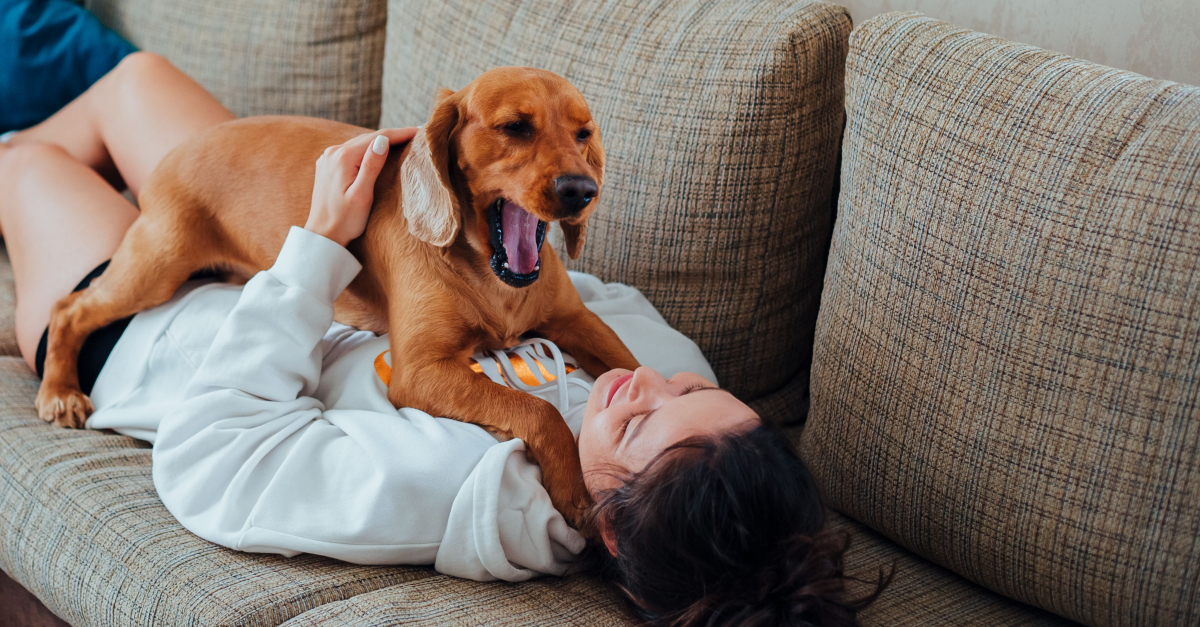
Have you ever heard of “contagious yawning”? This mechanism corresponds to yawning after seeing, hearing or even simply thinking of someone yawning. Relatively common in humans, it affects a large part of the population, and it is often associated with phenomena of emotional contagion which could have a possible link with empathy. But what about our 4-legged friends? Do dogs also have this contagious yawning reflex?
This phenomenon has actually also been observed in our canine companions, opening the question of heterospecific empathy, that is to say the ability to react to the emotions or behaviors of another species. A study carried out by researchers at the University of Tokyo and published in PLoS ONE* was interested precisely at this point.
The contagious yawn test in dogs
To better understand contagious yawning in dogs, the team of researchers from Teresa Romero tested the role of familiarity. The experiment thus consisted of exposing domestic dogs to 2 types of human models: their owner (a familiar figure) and an unknown experimenter.
In each case, the humans performed either a yawn or neutral mouth movements, in order to compare the doggies' reactions. The researchers then observed whether the dogs yawned in turn and also measured certain physiological indicators, such as heart rate, to assess their emotional state.
In total, 25 dogs living in homes participated in the study, and were tested individually in their usual environment in order to limit stress. An adaptation phase was planned before the tests to get them used to the equipment and the people present, and only dogs comfortable with strangers were selected.
Dogs yawn more with a familiar person
The results of this experiment showed that dogs yawned more often when they observed a human yawn than when they saw neutral movements. They yawned even more when this gesture was performed by a familiar person, such as their owner. No signs of physiological stress (particularly in terms of heart rate) were noted, which suggests that the phenomenon was not linked to anxiety.
These results therefore point towards a possible role of the attachment bond and social cognition mechanisms close to empathy, where dogs would react more strongly to the behaviors of their human relatives. When your dog yawns at the same time as you (or just after you), this can reflect a very powerful emotional bond between you. A dog who is very attached to his master will indeed be attentive to his gestures and emotions.
Faced with these results, however, researchers remain cautious: certain alternative explanations, such as attention bias or effects linked to methodology, could also come into play, and the scientific debate on the exact origin of contagious yawning in dogs remains open.
Woopets Info – Why does a dog yawn?
Contrary to popular belief, yawning in dogs does not only reflect fatigue. It is a real communication tool that can reflect one's emotional state:
- Fatigue or relaxation: a relaxed dog who yawns is often simply resting;
- Attachment, empathy: some dogs yawn in response to their master, a sign of a strong emotional bond as we have just seen;
- Stress, anxiety: yawning is a calming signal used to manage an uncomfortable situation;
- Discomfort or intimidation: it can appear in front of strangers, at the veterinarian or in a new environment;
- Boredom: a lack of physical or mental stimulation can encourage yawning;
- Confusion during training: it may indicate that the dog does not understand an instruction;
- Reaction to a reprimand: he then seeks to reduce tension and calm down.
The key to understanding what your dog is trying to express when he yawns is to observe the context and other bodily cues.
* Romero T, Konno A, Hasegawa T., “Familiarity Bias and Physiological Responses in Contagious Yawning by Dogs Support Link to Empathy”, PLoS ONE 8, 2013.