
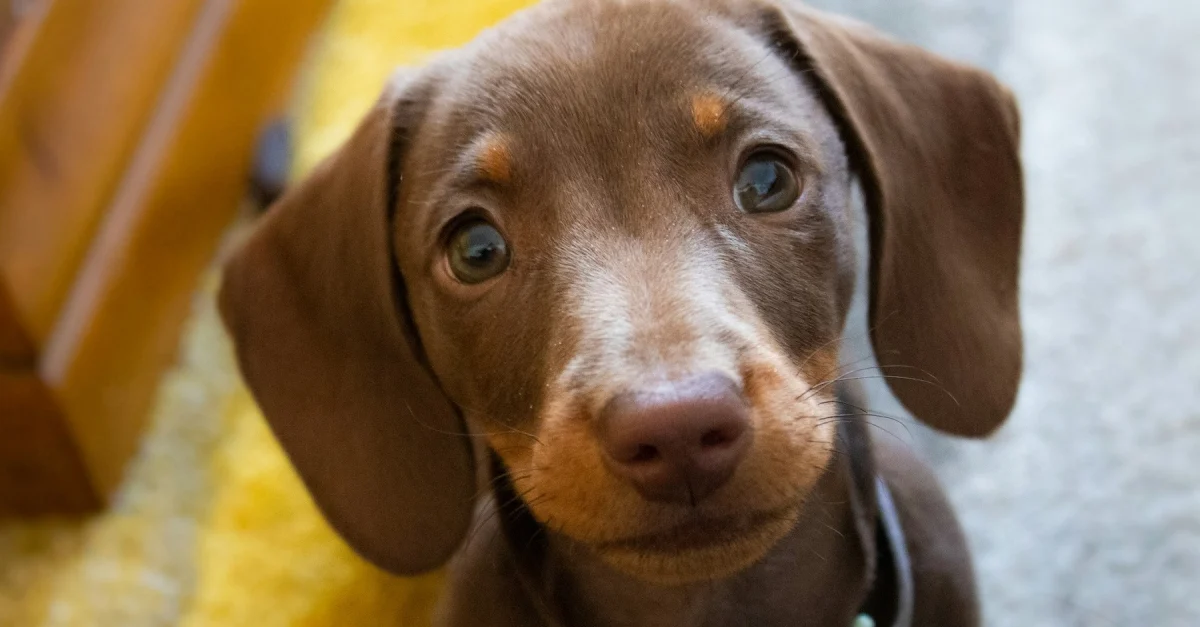
Scientists have long wondered about the mechanisms that allowed dogs to form such a strong bond with humans. To try to answer this question, a team of British and American researchers studied the facial anatomy of domestic canines and gray wolves.
In addition to having carried out comparative dissections on several animals in order to observe their facial muscles, the scientists analyzed the behavior of 27 doggies and 9 wolves filmed during interactions with strangers. Their goal? Measure the frequency and intensity of a particular facial movement: the lifting of the inner part of the eyebrows, responsible for the famous “hanging dog” look.
A facial muscle present in dogs
The results highlighted a major anatomical difference between the 2 species. Dogs almost always have a muscle called levator anguli oculi medialis (LAOM), which allows the inside of the eyebrows to be strongly raised. In the wolves observed, this muscle was absent or reduced to a few poorly developed muscle fibers.
Behavioral analysis confirmed this distinction. Dogs produced the movement much more frequently than wolves and with significantly greater intensity. The most marked expressions have only been observed in doggies.
According to the authors of this study, this movement visually enlarges the eyes and gives the dog's face a more youthful appearance. It also recalls certain human expressions associated with sadness or vulnerability.
A change in anatomy
Researchers believe that this muscle would have been favored over generations by selection exercised, consciously or not, by humans. Animals capable of producing particularly endearing expressions would have benefited from better attention, more care and, potentially, a better chance of survival.
Thus, the famous pleading look of our faithful 4-legged companions could be the result of thousands of years of co-evolution with Man. This hypothesis is also consistent with the idea that dogs have gradually developed several characteristics that favor communication with us, whether it be their behavior, their vocalizations or their facial expressions.
This shows that their domestication would also have modified their anatomy right down to the muscles of their faces, allowing them to communicate more effectively with humans… and melt our hearts with a simple look!
* “Evolution of facial muscle anatomy in dogs”, Juliane Kaminski & al, PNAS, June 2019.