
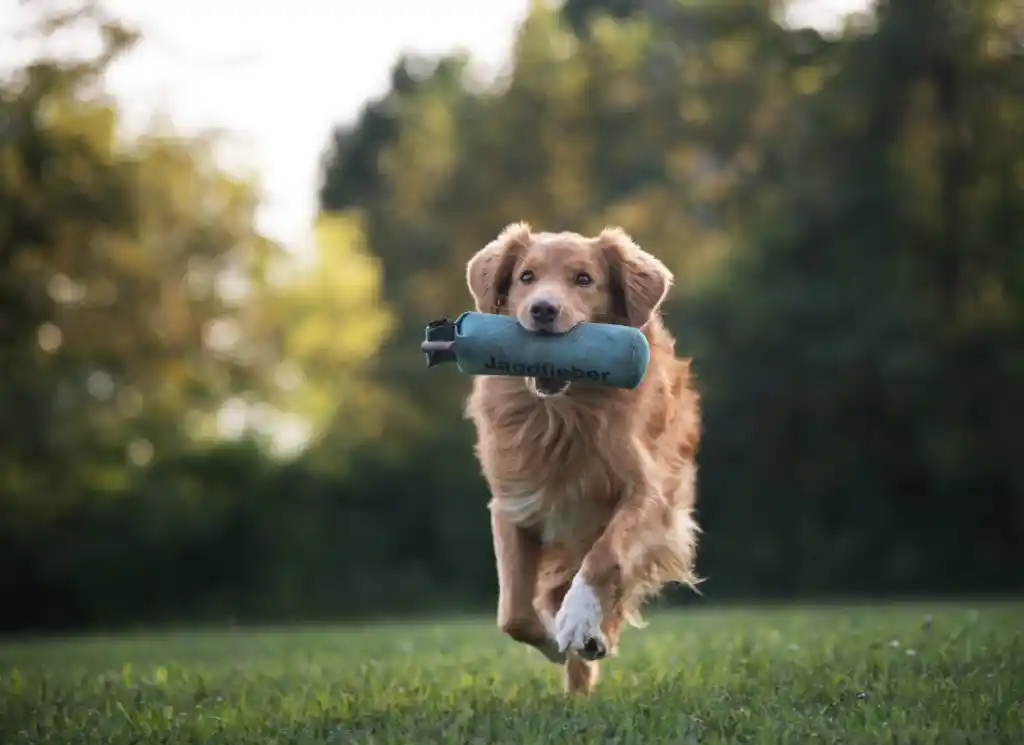
Searching or playing games in everyday life is much more fun when your dog brings you what he finds and gives it to you. In today's article I'll show you how delivery training can be structured and why such a structure makes sense.
Structure the submission in a structured manner
 Correct Play: Your dog will learn how to properly (with you) plays. This way he notices how exciting you are and that playing without you is boring. In this way, you become the trigger for the fun and encourage his joy.
- Giving and exchanging: You show your dog that a toy doesn't just disappear as soon as it lands on you. It's just as fun, just with a new toy. This is how your dog understands: “Aha!” Giving and exchanging isn't a bad thing, the game isn't over then!”
- Hand target: Your dog learns that there is one goal, and that is the hand! Once he has noticed that something great happens when he puts his nose on your hand, he will transfer this knowledge to the delivery. Once you have introduced the hand signal, you can always fall back on it later when things get difficult, for example in exams.
- Bring: Only now do you begin to actively practice bringing it. Your dog picks up toys and brings them to you. The important thing is that it actually brings it to you and not just to a point that is roughly in your direction.
Reading tip: Here you will find tips and basic rules to help you get off to a good start in delivery training. - Delivery: Once you have practiced all of this, you can move on to training the delivery. Now it's just a matter of showing your dog that and how you want to hold the toy or dummy. When your dog makes his way to you with the toy he has found, slowly walk backwards while showing your “target hand”. Your dog can't throw the toy at your feet because you're moving. The only way for him to swap the toy for another is to put the toy in your hand. And you've already trained your first delivery into the hand!
- Hold: You should only practice holding at the very end, when you have already practiced bringing it sufficiently and the delivery is also secure. This way you avoid difficulties, for example your dog deliberately not bringing you anything so that he doesn't have to keep it boring.
Why the order is crucial Bringing first and holding at the end? Won't my dog get really excited and later no longer be able to give up calmly and properly? No! Although this myth persists, it is just that: a myth. Young and energetic dogs in particular benefit from devoting themselves to fetching first during delivery training and only concentrating on delivery and holding later. In this way, they can first learn how much fun it is to do something together with their human through relaxed exercises in which they can be active. If you start with rather rigid tasks such as handing things over or holding them, they quickly put themselves under pressure because they find it difficult to suddenly have to be quiet. Sometimes they are so tense that they even hold their breath.
That's why it's important that your dog first learns how to be calm and relax before you train him to hold him. Calmness is not something that can be forced – it has to be learned by the dog. To do this, you have to show him that he can just enjoy lying around and doesn't have to do anything.
Tip: If you want to know more about how you can train to lie down, read my article “Everyday exercises for every dog”.
But you can also start hand-off training before your dog has learned to go down: playing, exchanging and fetching correctly allows your four-legged friend to practice important elements of hand-off without having to force himself to calm down and practice under pressure.
Conclusion: Success with structure The recipe for success for delivery training is a structured approach. Practicing fetching first and then releasing and holding it helps mainly excited dogs because they don't have to force themselves to calm down and thereby put themselves under pressure. Instead, they can get to know and practice important steps in setting up the submission while having fun and at their own pace. Systematically building up the delivery training also has other advantages: You don't have to wait until the delivery is secure before training, but you can always work with what your dog can already do. This way you don't put pressure on yourself that everything has to work perfectly straight away and you can enjoy training again. If you want to know why I never give the “stay” signal but my dogs can still wait for minutes, stay tuned for the next article. See you soon!
Here is the relevant podcast episode on the topic: Delivery in the hand.
Tip: Further contributions from Susanne Reinke
Was this amount interesting or helpful?
Your rating shows us what you and your furry friend like – it's like a treat for us.