
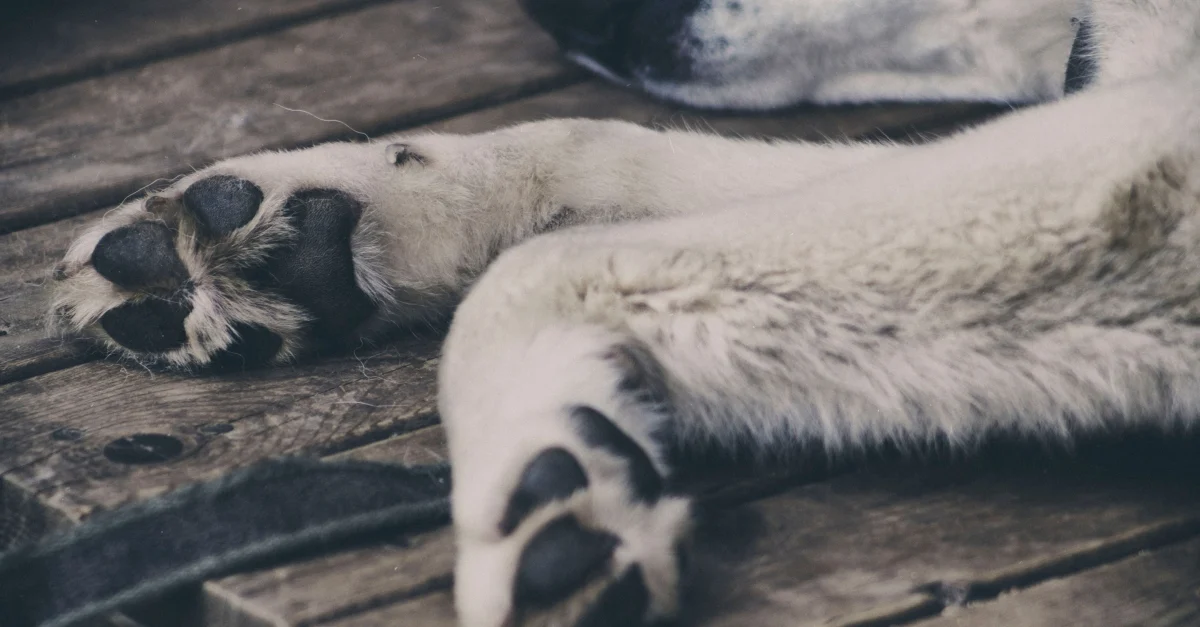
Unlike us, dogs do not walk by placing the entire sole of their feet on the ground. Indeed, it is a digitigrade, which means that it moves by relying on its fingers, or more precisely on its phalanges. And if it has 4 clearly visible fingers on each paw, it also has a little “bonus”: the dewclaw, often compared to our thumb. Located higher on the paw, it generally does not touch the ground, but can be useful…
What exactly is ergot?
The dewclaw is this small claw located higher up on your dog's front legs. Contrary to popular belief, it is not just a simple evolutionary vestige of its canid ancestors: at the front, it is generally connected to the paw by bones and ligaments and can even come into contact with the ground during acceleration, jumps or turns, thus helping to stabilize the carpus.
The dewclaws are generally present on the front legs, where they correspond to the famous “5e finger” of the dog. But some breeds can also have them at the back, sometimes even double. Unlike the front dewclaws, these small rear appendages are generally connected to the paw only by the skin. In breeds like the Pyrenees Mountain DogTHE BriardTHE Beauceron or the Icelandic Shepherdthese double rear lugs are even a recognized characteristic of the breed standard.
What do dewclaws really do in dogs?
At the front, the dewclaw can play a real role in the dog's movements, notably by providing stability to the wrist when running, jumping or negotiating a turn at high speed. It can also help him to grip a toy or a bone between his paws, to gain support on a slippery surface or to move on steep terrain. In working or particularly sporting dogs, this little 5e finger can therefore be a precious ally.
In certain breeds such as Beauceron or the Patouthe double rear lugs could even have a particular function on uneven terrain. In short, behind this little claw that we sometimes consider useless is actually a rather well thought-out anatomical accessory!
Woopets info – How to take care of your dog’s dewclaws?
Like the other claws, the dewclaws deserve a little regular look. And since they rarely touch the ground, they don't wear out naturally: they can become too long, snag, break or even end up penetrating the skin. To avoid these little injuries, a few precautions are enough:
- Check their length regularly by passing a finger under the lug to see if it catches (if it catches easily, it's probably time to cut it!);
- Prune them regularly: cut just enough so that the dewclaw no longer clings, taking care not to reach the living part of the claw;
- Watch for signs of injury: a broken, torn or loose dewclaw can be particularly painful and sometimes requires veterinary consultation;
- Do not remove a dewclaw yourself! In certain cases, especially when it is very mobile and at risk of tearing, a veterinarian may recommend its removal. For the front dewclaws, however, this decision is taken with greater caution, since they can contribute to the stability of the paw;
- If there is a problem, go to the veterinarian: depending on the situation, he or she can trim or remove the injured dewclaw and offer appropriate care.