
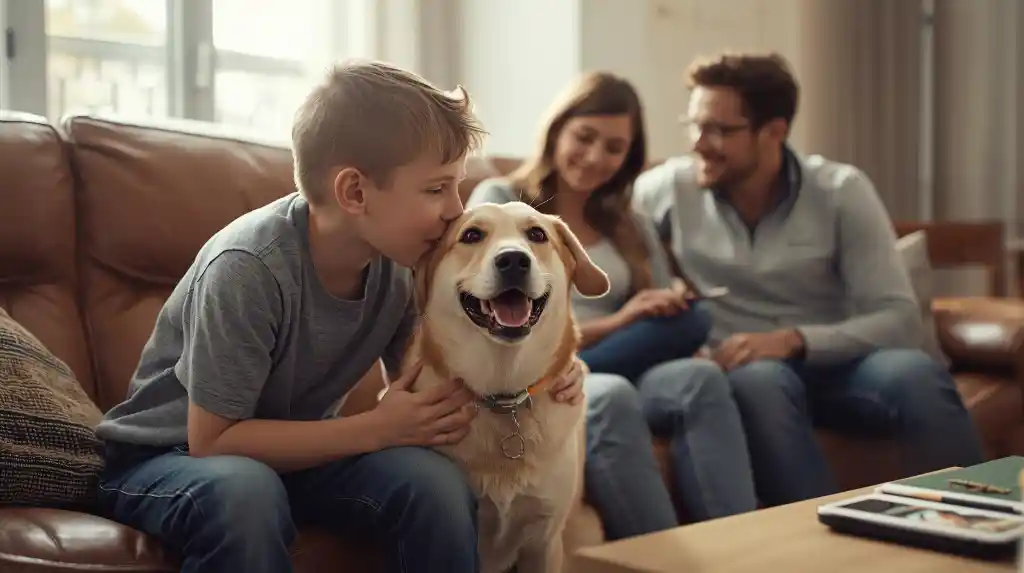
Dusseldorf. Dogs enrich family life. By 2025, every fifth household in Germany had at least one family member living on four paws. But owning a dog also brings with it responsibility. A clear and realistic distribution of tasks within the family is important for a harmonious everyday life with four-legged friends. Those who carry out care, training and organization together not only relieve the burden on individuals, but also give the dog security through reliable structures.
When a dog moves in, the overall responsibility for its welfare always lies with the adults. They make the basic decisions about nutrition, health, education and spending. This also includes vet visits, insurance, training and an assessment of whether the dog is well cared for. “Even when tasks are delegated, adults remain the reliable coordinators who ensure that routines are adhered to. They intervene when a child is overwhelmed or the dog signals stress or other discomfort,” describes Sabine Winkler, dog trainer and guide author. “A dog needs clear reference people and reliability.”
Young people: reliable support in everyday life Parents should teach their children how to handle the dog and guide them at the beginning. “From around the age of 12 to 14, young people can contribute to dog care largely independently and take on regular walks, feeding or grooming,” says the expert. The prerequisite for this is that they complete their tasks reliably and not just when they are in the mood. Since a dog should respond to fixed commands or signals, it can make sense to carry out dog training together. This makes it a family time at the same time and strengthens the bond between two-legged and four-legged friends.
Children of primary school age: learning responsibility
Children between the ages of 6 and 11 can also be involved in the care, but not yet independently. There should always be a parent present to supervise the dog and child. “Children can help measure the food, fill up the water, brush the fur, go on walks and of course play with the dog,” explains Winkler. “In doing so, they learn to recognize needs, be considerate and gradually take on responsibility.” Although the main responsibility clearly remains with adults, children literally grow with their tasks.
Small children: observe, do not look after
Girls and boys of kindergarten and preschool age cannot yet take on fixed tasks and should not be left alone with the animal. For them, getting to know each other carefully is the priority. Adults have the task of accompanying the contact between dog and child and setting boundaries – for both sides. Treating each other with respect, recognizing periods of calm and recognizing that a dog is not a toy lay the foundation for mutual understanding and long-term friendship.
Clear agreements create security
Regardless of the age of the children, it is important to clearly discuss and distribute tasks. Who will take the walk in the morning? Who takes care of feeding in the evening? This creates security, prevents misunderstandings and ensures harmony in the dog household.
Pet Supplies Industry Association (IVH) e. v.
Was this amount interesting or helpful?
Your rating shows us what you and your furry friend like – it's like a treat for us.