
Why do some dogs react to storms before we even notice the first signs? Quite simply because their senses are much more developed than ours. Their great sensory sensitivity allows them to spot certain subtle changes in their environment, sometimes long before we notice them.
A sixth sense? What your dog perceives before you
Dogs have particularly developed senses which allow them to perceive certain warning signs of a storm well before us. When barometric pressure drops as rain approaches, some doggies may detect this change and become more anxious or agitated.
The atmosphere preceding a storm can also encourage the accumulation of skin static electricity on their coat, sometimes causing unpleasant sensations, such as tingling.
Their particularly fine infrasonic hearing also allows them to perceive distant sounds and rumblings that we cannot yet hear.
All of these signals can therefore explain why your dog seems to know that a storm is approaching while you have not yet noticed anything.
Hiding: a reaction to discomfort, not a prediction
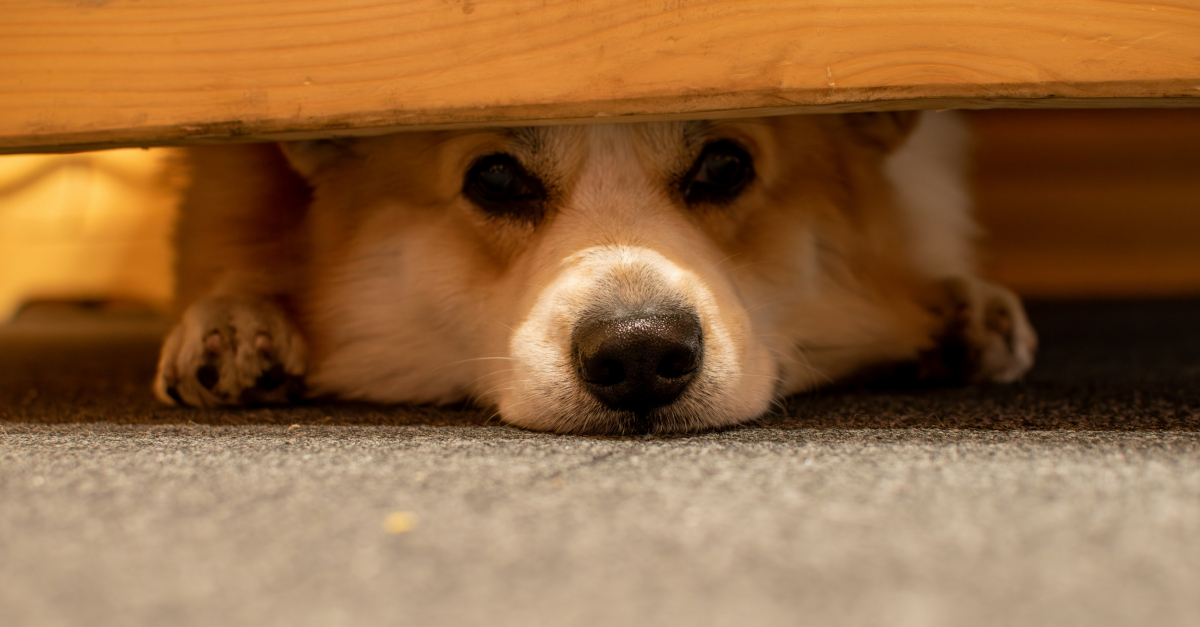
When the first signs of a storm are felt, some dogs instinctively seek refuge under furniture, in their kennel or in another enclosed space. This behavior does not mean that they have a mysterious “sixth sense” capable of predicting storms: rather, they react to changes in their environment that they perceive before us. Drop in barometric pressure, distant rumbling, vibrations or static electricity can cause discomfort, stress or anxiety. In some doggies, this reaction can even go as far as a real phobia of storms.
Slipping under a bed, a table or in a small space then offers them a feeling of security and allows them to isolate themselves from the stimuli that worry them. It is therefore more of a reaction to discomfort and the need for reassurance than a real ability to predict the storm.
Woopets info – How to react if your dog hides under furniture before a storm?
If your dog runs to take refuge under a piece of furniture as soon as a storm brews, there is no point in dislodging him or forcing him to confront what is worrying him. This behavior often makes him feel safe. However, a few simple actions can help them get through this moment more peacefully:
- Leave him in his hiding place: if he finds comfort there, it is better to respect his need to isolate himself;
- Stay calm: your dog can sense your own stress. A calm, normal attitude can help him relax;
- Set up a comfortable shelter (a basket, a blanket or a quiet corner where he can retreat freely);
- Don't force him out or scold him, because he needs to be able to handle the situation at his own pace;
- Distract him if it works: a toy, a treat or an activity he enjoys can sometimes distract his attention from the sounds of the storm;
- Monitor his behavior: if his fear becomes very intense or repeats itself with each stormy episode, talk to your veterinarian, who will be able to advise you.