
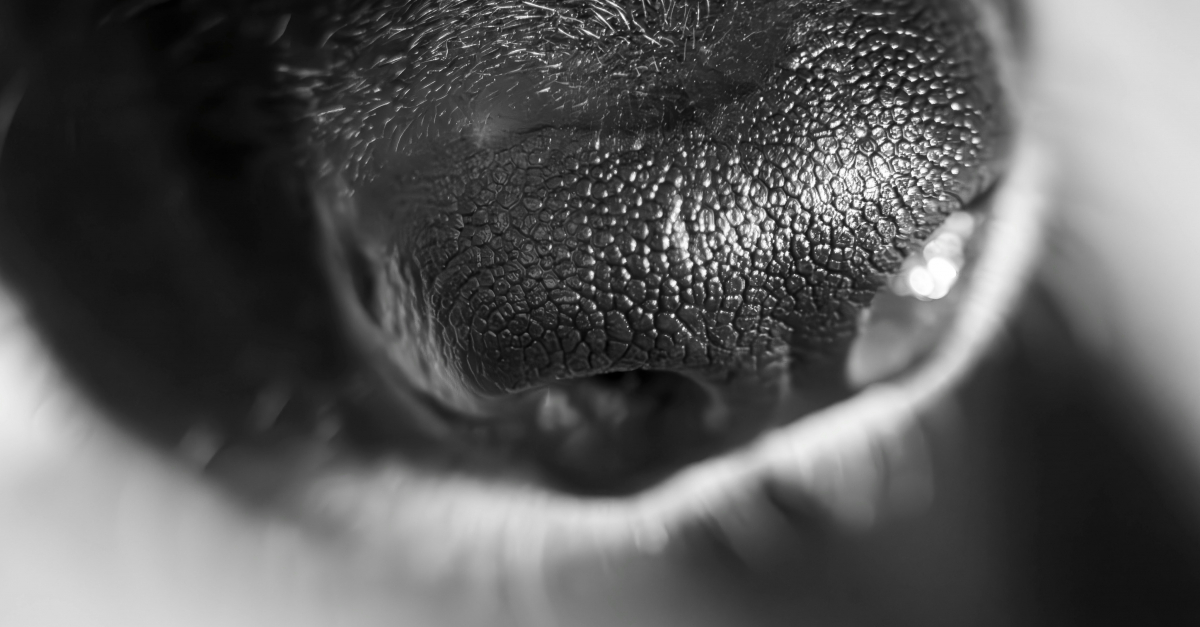
We know the dog's nose for its unparalleled sense of smell, capable of detecting odors that completely escape us. But this little wet nose hides another astonishing feature: patterns unique to each animal. A characteristic which has long been used to identify dogs, well before the arrival of tattoos and electronic chips.
A unique truffle?
As surprising as it may seem, your dog's nose is unique, just like our fingerprints! Indeed, its rhinarium, this moist and hairless area that we colloquially call the nose, is covered with small ridges and furrows forming a design specific to each individual.
Comparable to our dermatoglyphs, these patterns have intrigued scientists since the 1930s. Since then, research* has confirmed this astonishing singularity. Thanks to photographs analyzed by biometric algorithms, researchers have shown that these patterns can indeed distinguish individuals, including dogs from the same litter!
Before the tattoo then the electronic chip and the file managed by theI-CADthe nose print has also been used as an official means of canine identification. A nice proof that, long before canine biometrics became a technological reality, your companion already had a very personal signature on his muzzle.
Could the truffle become an identity card again?
What if, tomorrow, it was enough to photograph your dog's nose to immediately know who he is? After having been used as a means of identification well before the arrival of the electronic chip, the rhinarium print could well have a second life thanks to advances in canine biometrics and image recognition. The principle is simple: record the unique pattern of ridges and furrows of the nose in a database, then compare it to a simple photo taken with a smartphone. Experiments are already going in this direction: the application NODEiDdeveloped by iams and tested in beta version at UNITED STATESthus explores the possibility of identifying a dog from the scan of its nose.
Other experiments have also shown the potential benefit of this technology for finding lost or stolen animals, by matching their nasal prints to a database. We could then imagine real truffle files, a bit like the biometric bases used for human fingerprints.
Be careful, however: the technology is still in development and raises many questions, in particular on the reliability of the images, data protection and the need for prior registration. The idea nevertheless remains attractive. Tomorrow, your dog could perhaps be recognized with a simple “click” just with his little nose!
* See for example: Choi HI et al., “Study on the Viability of Canine Nose Pattern as a Unique Biometric Marker”, Animals (Basel), 2021 Nov 25;11(12):3372.