
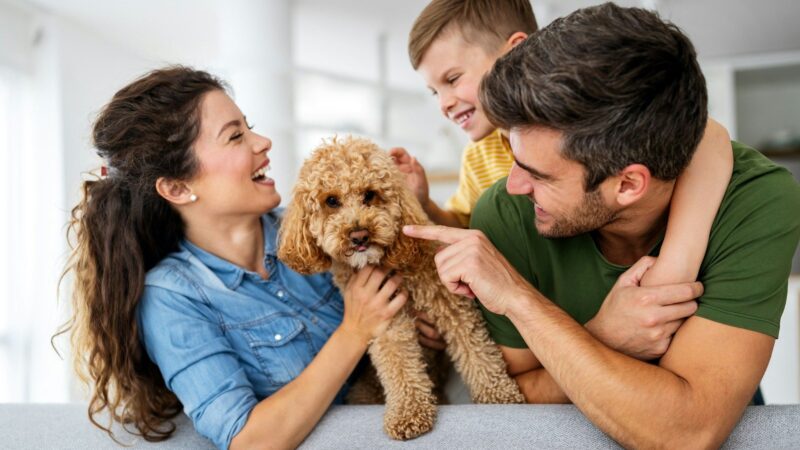
Many dogs copy human actions that are actually irrelevant to achieving their goals. This over-imitation is being tested in numerous experiments at the Messerli Research Institute in Vienna. Messerli researcher Shany Dror was recently able to show that some dogs can only learn words by listening to conversations – similar to small children.
Vienna. The connection between people and dogs is unique. They have been interacting, complementing and helping each other for tens of thousands of years. Hardly any animal is better at understanding people, interpreting their actions and learning from them. An important mechanism behind these abilities is so-called overimitation. Similar to children, dogs imitate human behavior that is of no immediate benefit to them – from apparently singing along while playing music to opening their mouths when people yawn.
While the complex aspects of overimitation in children have already been well studied, the phenomenon in dogs has only been systematically researched for a relatively short time. A pioneer in this area is the Clever Dog Lab of the Messerli Research Institute for Human-Animal Relationships, a joint institution of the University of Vienna and the Vetmeduni Vienna. In the current project “Overimitation in Dogs,” which is funded by the FWF Science Fund, researchers are working on experimentally testing central hypotheses from previous research. At the same time, project employee Shany Dror was able to show in a recent publication in the journal Science that the learning abilities of some dogs are much more extensive than previously thought.
Animals, people and culture The question of over-imitation has a complex background. It goes far beyond behavioral research and touches on fundamental questions of culture and social learning. “In children, imitating actions that are not relevant to achieving a goal is often seen in a cultural context: they are attempts to follow social rules, even if one does not understand them. There is no question that the technique of over-imitation has helped to produce complex human culture,” outlines Shany Dror, who is researching together with Ludwig Huber, head of the FWF project, and other colleagues. “This is interesting in the context of dogs because it is often assumed that people’s culture is a factor that distinguishes them from animals.”
Over-imitation has not yet been proven in other animals – including great apes. Dogs, which developed in the same environment as humans during their long-term domestication, are the only animal species to date in which this ability has been proven. “Probably those dogs that understood human communication best and fit best into their community were able to reproduce most often,” explains Dror. “Dogs are therefore subject to similar evolutionary pressure as humans – an aspect that makes the social behavior of animals particularly interesting for research.”
(Not) a question of relationship
As part of the project, Dror and her colleagues are investigating three specific questions. The first of these concerns the relationship between animals and their owners: Does the quality of the relationship influence the tendency to overimitate? A study by Dror's colleague Karoline Gerwisch, who examined the behavior of animals in their environment in their owners' homes, has already provided surprising insights. It showed that assistance dogs, which, according to the survey, have a closer bond with their caregivers, do not show significantly higher levels of overimitation than family dogs. Their tendency to over-imitate was even lower – this could have something to do with the dogs' special training.
Dror himself tries to explore the influence of the bond with his owner in a completely different way. She focuses on the hormone oxytocin, which influences social bonds – in dogs as well as in people. “In my study, I am testing whether higher levels of oxytocin in dogs, which usually increase attention to social signals, also promote the tendency to overimitate,” says Dror. The results should provide further important information about the role of the human-animal relationship in this behavior.
Is it all just a misunderstanding?
Another set of questions in the project deals with the motivation for over-imitation. Do dogs understand that they don't have to perform acts of overimitation in order to achieve their goals? Or are they subject to a misunderstanding and do not realize that their behavior does not bring any functional benefit? The research strategy here is to find imitation tasks that are not only irrelevant, but also make the animals aware of this irrelevance. For example, a human may make an obviously unnecessary gesture to reach a treat in a box – will the dog copy it?
Finally, the question will be examined as to whether over-imitation is not only related to evolution and domestication, but also to the individual development and socialization of animals. On the one hand, the experiments work with puppies in order to compare their behavior with adult animals. On the other hand, the comparison between dogs and wolves is in the foreground. “Although they are genetically closely related, there are enormous differences in the behavior of dogs and wolves that could shed light on the development of over-imitation,” says Dror. “Even though working with the wolves is challenging, we still hope to be able to achieve reliable results.”
The amazing abilities of canine geniuses In her dissertation at Eötvös Loránd University (ELTE) In Budapest, Shany Dror has already worked with a very rare group of dogs who have special abilities: the so-called Giftet Word Learner Dogs, who are extremely talented at learning names for objects. It is known that they can memorize hundreds of object names through interaction with their owners. Dror and colleagues at ELTE were now able to present a highly acclaimed new finding in a publication in the journal Science. “We show that these dogs can learn new words even when they listen to two people talking,” explains Dror. “And not only that: this learning process was also just as good and effective as that through direct interaction.”
The “gifted word-learning dogs” surprisingly display abilities that are comparable to those of 18-month-old toddlers. But the underlying mechanisms and cognitive abilities are probably different, says Dror. “I think future research will find differences in the extent to which children and dogs can take the perspective of those involved and understand the underlying mental processes.” Nevertheless, the better scientists like Dror understand the behavior and cognitive abilities of dogs, the clearer it becomes that once firmly established boundaries between humans and animals are increasingly beginning to falter.
About the researchers
Shany Dror is a postdoctoral researcher at the Clever Dog Lab of the Messerli Research Institute for Human-Animal Relationships, an inter-university institution at the University of Veterinary Medicine Vienna (Vetmeduni) as well as the University of Vienna and the Medical University of Vienna. She completed her doctorate at the Department of Behavioral Biology at Eötvös Loránd University (ELTE) in Budapest. Her work with the rare Gifted Word Learner Dogs and the associated “Genius Dog Challenge” experiments, which were broadcast live online, have already received worldwide media attention.
Ludwig Huber is professor for the scientific foundations of animal ethics and human-animal relationships, head of the department for comparative cognitive research at the Messerli Research Institute, which also includes the Clever Dog Lab, and currently also head of the overarching department for interdisciplinary life sciences at the Vetmeduni Vienna. His research focuses on animal cognition in a broad comparative approach. The “Overimitation in Dogs” project runs from 2024 to 2027 and is funded by the FWF Science Fund with 449,000 euros.
Austrian Science Fund FWF