
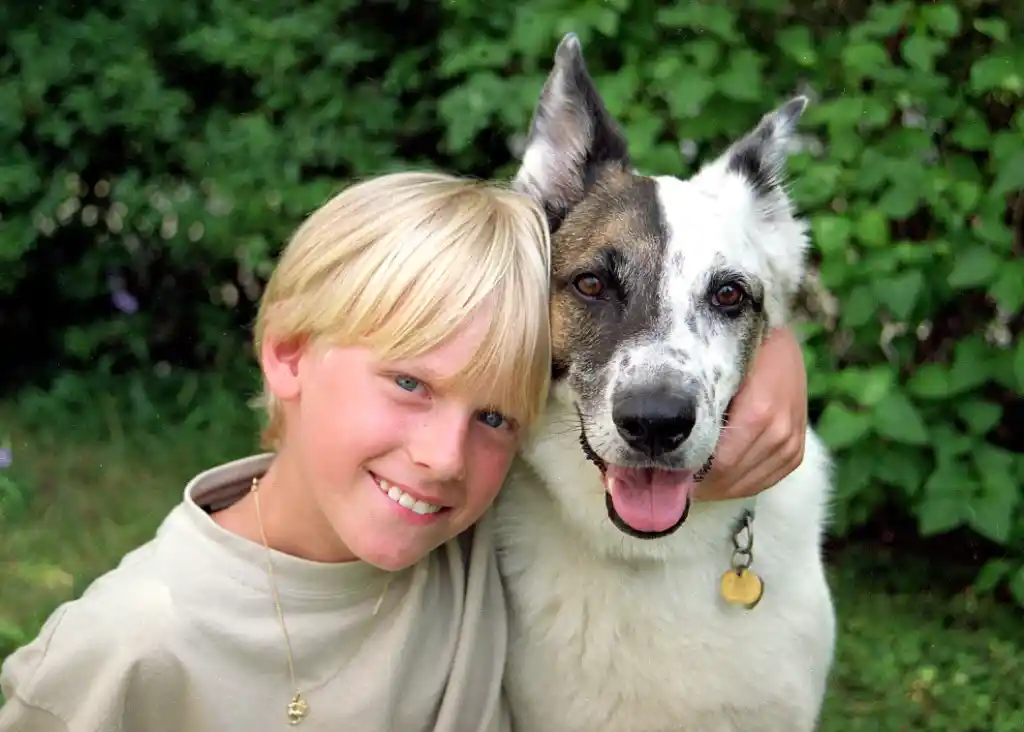
How the youngest family members get used to each other
Dusseldorf. It is a dream for many parents: dog and child form a familiar team and master everyday life together. The basic prerequisite for this is that contact between four-legged and two-legged friends is accompanied educationally. Because dogs find some childish approaches invasive – and children first have to learn to understand the subtle signals of their counterparts. With good planning, clear rules and a lot of patience, a relationship can be created that lasts the animal's life.
The well-rehearsed duo of child and dog does not emerge overnight, but develops with every positive shared experience. Adults have the responsibility to protect and guide both sides. This effort will be worth it in the long term: “Children learn consideration and empathy through dogs,” says Dr. Barbara Schöning, Chairwoman of the Society for Animal Behavioral Medicine and Therapy (GTVMT). “And dogs benefit from clear structures and most enjoy attention – a real win-win situation.”
Tip 1: Model good behavior towards dogs If children want to pet a dog, adults should actively accompany the situation – regardless of whether it is your own family dog or an animal you meet on the go. The adults must ensure that both are in a safe environment. It is important that the dog can escape at any time and is not held or harassed. Children learn this best by example: calm movements, quiet voices and a respectful distance give the dog security. Ideally, you approach from the side and let your four-legged friend decide whether he wants to make contact. “A dog should never be forced into contact – neither by adults nor by children,” emphasizes Dr. Schöning. “Voluntariness and respect for individual boundaries are the basis for trust.”
Tip 2: Set up clear rules that children can implement
Children benefit from simple instructions that they learn and internalize over a few repetitions. This includes, for example, first asking the dog whether he would like to be contacted. This can work verbally, or quietly and quietly by calmly holding out your hand. The child should also learn to stroke the dog's side of the shoulder or chest and not to reach over the dog's head from above. If your four-legged friend is eating, sleeping or withdrawing, it should be left alone.
Rules like these not only help children learn how to take responsibility for their actions, but also give the dog orientation in everyday life.
Tip 3: Translate dog language for the child
Dogs communicate primarily through body language – and children should learn to read this. “If the dog feels comfortable, this is reflected in a relaxed posture, relaxed facial features and possibly a slight wagging of its tail. If it voluntarily stays nearby or even seeks contact itself, that is also a good sign,” explains the expert.
Stress and discomfort, on the other hand, manifest themselves more subtly. “Sometimes the dog turns its head away, appears tense or frequently licks its snout. But seemingly relaxed gestures such as conspicuous yawning can also be a signal of stress. It is always crucial to pay attention to the entire body language in order to classify the situation,” says Dr. Schöning. Clear stop signals include a tucked tail or if the dog tries to withdraw from the situation. Even well-socialized dogs need breaks and places to retreat that are taboo for children.
Tip 4: Gently get dogs used to children's hands Children first have to learn how to caress properly. Babies and small children in particular often touch uncoordinated, gripping too hard or moving jerkily. To prepare dogs for this, we recommend gradual training in a quiet environment. Short practice sessions help to build confidence. For example, adults can simulate touches that are initially gentler and then slightly more clumsy and reward the dog for remaining calm.
It is also helpful to associate the child's touch with positive things, such as a treat or calm, friendly words. However, you should make sure that the dog does not become too hectic and excited by the treat, for example. This is how he learns that being close to children is not a threat.
Pet Supplies Industry Association (IVH) e. v.